Time-series similarity articles
These articles compare tasks, mathematical assumptions and software interfaces. They do not report a new cross-library benchmark.
- Time-series similarity: choosing between DTW, matrix profiles and learned representations · en
- 时序相似性方法盘点:DTW、矩阵轮廓与学习表示该怎么选 · zh-CN
- What Does Similar Mean for a Time Series? A Mechanism-Level Tour of Distances, Alignments and Representations · en
Compare mechanisms on the same curves
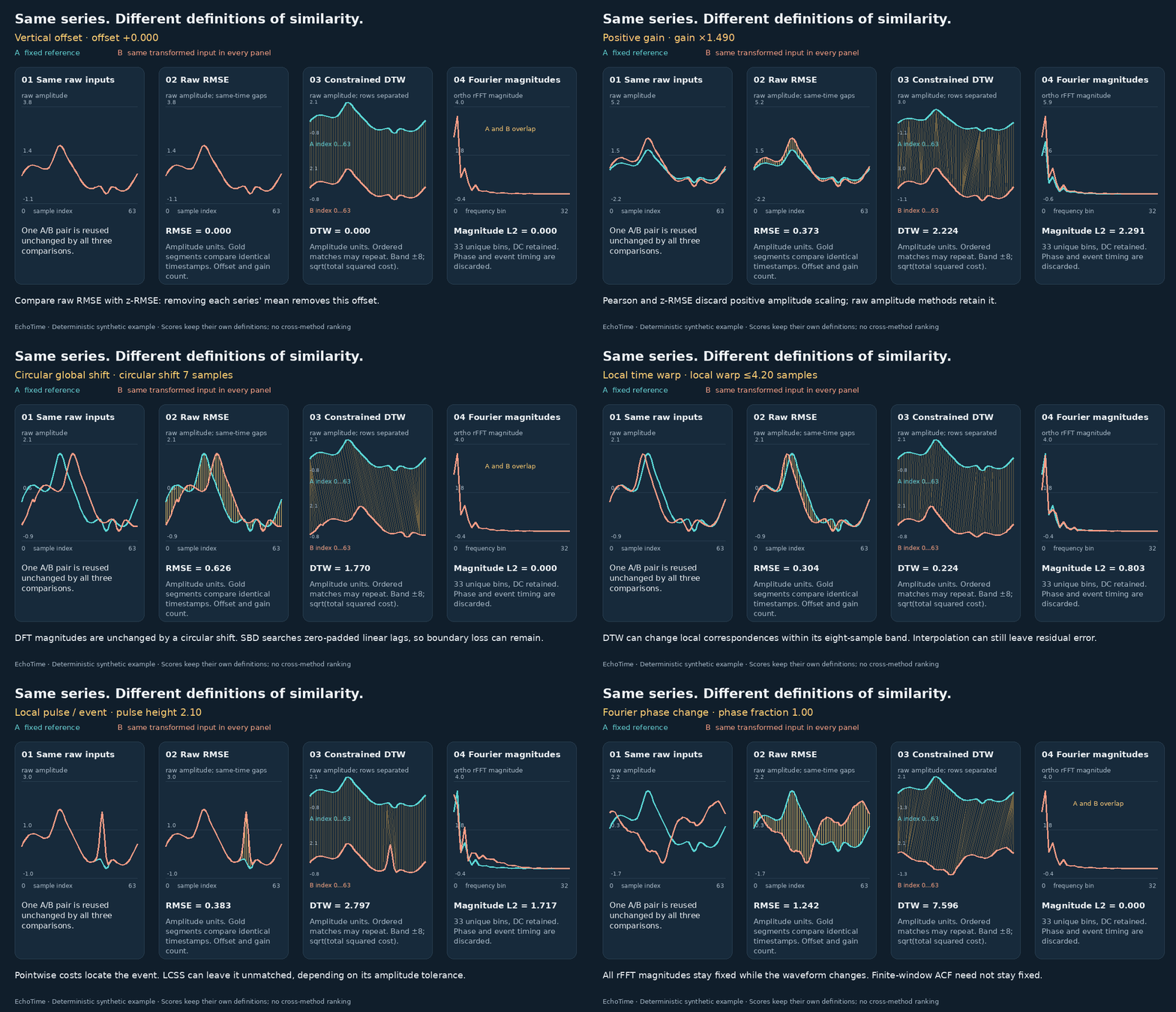
The interactive similarity lab holds one reference curve fixed while changing offset, gain, global timing, local warping, a local event, Fourier phase or sample order. Compare eleven explicit method definitions through their actual alignments, features and contributions. The new mechanism tour connects those observations to the original papers and includes three reproducible numerical examples.
Open the overview GIF or discuss assumptions and suggest examples.
Evidence ledger
The ledger was assembled before drafting. Citation roles describe what each source supports; recommendations in the articles are explicitly presented as a proposed evaluation procedure. Software documentation was checked on 2026-10-29. This is a targeted narrative comparison, with no claim of systematic-review completeness. No library speed or accuracy ranking was measured for these articles.
| Claim or object | Role | Primary source | Boundary |
|---|---|---|---|
| DTW aligns ordered observations under admissible paths; local cost and path constraints define the result | Definition / Tool | tslearn DTW guide | A package's transformed similarity score need not equal a canonical raw DTW distance |
| SBD uses normalized cross-correlation to allow a global shift; k-Shape also defines a centroid procedure | Origin / Definition | Paparrizos and Gravano, SIGMOD 2015 | A global shift differs from local nonlinear time deformation; classification/clustering results do not establish universal retrieval performance |
| shapeDTW aligns sequences of local descriptors | Origin / Definition | Zhao and Itti, Pattern Recognition 2018; author preprint | Descriptor and neighbourhood settings are part of the method |
| ADTW adds a penalty for warping | Origin / Definition | Herrmann and Webb, Pattern Recognition 2023 | Parameter scale and tuning protocol matter; no claim of task-independent dominance |
| Soft-DTW replaces hard path minimization with a smooth aggregation | Origin / Definition | Cuturi and Blondel, ICML 2017 | Differentiability requires a suitable ground cost and positive smoothing parameter |
| Raw soft-DTW can be negative; corrected divergences have assumptions | Limitation / Boundary | Blondel, Mensch and Vert, AISTATS 2021 | The paper's divergence result is conditional on the ground cost; it does not establish the triangle inequality |
| A matrix profile records nearest-neighbour distances for fixed-length subsequences | Definition / Tool | STUMPY matrix-profile tutorial | Standard formulation uses z-normalized Euclidean distances and a self-match exclusion policy |
| STUMPY supports joins between two series and optional normalization | Tool | STUMPY AB joins | Window length, join direction and normalization remain part of the query |
| TS2Vec learns hierarchical contrastive representations of timestamps and subsequences | Origin / Boundary | Yue et al., AAAI 2022 | Classification, forecasting and anomaly-detection evidence does not establish every retrieval objective |
| MOMENT supplies pretrained representations for multiple time-series tasks | Origin / Boundary | Goswami et al., ICML 2024 | Pretraining does not by itself determine a domain's similarity labels |
| TS-RAG retrieves segments to support forecasting | Origin / Boundary | Ning et al., NeurIPS 2025 | Forecasting improvement is an endpoint distinct from retrieval relevance |
| Multivariate comparisons depend on normalization and channel assumptions | Contrast / Boundary | d'Hondt et al., PACMMOD 2025; author institution record | Findings concern the evaluated measures, datasets and protocols |
| aeon offers distances, alignment paths, and whole-series/subsequence search | Tool | aeon distances; similarity search | Availability differs by estimator and installed version |
| tslearn offers time-series learning and DTW/soft-DTW-based workflows | Tool | tslearn documentation; user guide | Do not infer relative runtime from API availability |
| DTAIDistance provides C implementations, pruning, paths and pairwise matrices | Tool | DTW API | Its distance_fast name refers to the accelerated implementation; it does not imply downsampling |
| sktime supports multiple learning tasks and composable interfaces | Tool | sktime get-started guide | Treat as overlapping ecosystem functionality, not an exclusive category |
EchoTime's compare_series is a resampled, normalized, composite report |
Tool / Limitation | Inspected source | Fixed weights and qualitative labels are not calibrated probabilities; inspect later code for changes |
EchoTime's compare_profiles compares profile-axis summaries |
Tool / Boundary | Inspected source | Structural agreement does not establish shared mechanisms or successful model transfer |
Editorial checks
- Facts: linked methods to original papers or official documentation; kept literature coverage separate from implemented APIs; reported no new performance numbers.
- Expression: explained comparison objects and information loss before method names; used explicit assumptions for normalization, time alignment and multivariate channels.
- Distribution: one clear question per social card; links lead to the full comparison and reproducible package entry point. Social copy is stored as drafts in
social/2026-10-29-similarity-roundup.md.
Review links and implementation notes before reusing this material after package updates. The companion literature map records the broader paper inventory.
Built from the versioned Markdown source. Share questions, corrections and reproducible examples in GitHub Discussions.